Joseph Mallord William Turner is a British artist, born in 1775, London, England, his exact date of birth is unsure. By the age of 15 Turner had one of his paintings exhibited at the Royal Art Academy. When he was 18 years old, he already had an art studio. By the age of 27 he had become an associate of the Royal Academy. The artist died in on the 9th of December 1851 from a serious illness.
I have already briefly analysed Turner’s work before in my previous AS work, however I have decided to come back to this artist again, as I believe his work expresses light and atmosphere perception in a very unique way. I like how Turner’s painting of reality are blurred it out making the viewer focus on the surrounding lights and colours rather than the precise details.
Though his career, Turner used mediums such as watercolour, oil paint and prints. His oil paint technique was influenced by his watercolour paintings. His original style was created when he started using oil paint in a translucent manner, this technique created a similar effect to watercolour.
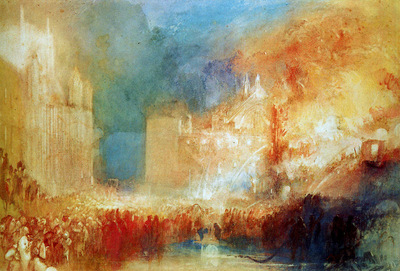
Here are examples of some of his artwork bellow

Above Joseph Mallord William Turner ‘The Burning of the House of Parliament’ Watercolour and gouache on paper, support 302 x 444 mm , currently in Tate Museum. (1)
In particular I want to analyse one of his painting called ‘Norham Castle, Sunrise’ which particularly well portraits how the artist tries to express his feelings about a surrounding he was in. (Bellow)
+Oil+on+canvas.jpg) Above Joseph Mallord William Turner “Norham Castle – Sunrise”. Created using oil on canvas in 1835-1840.Support: 908 x 1219 mm,frame: 1060 x 1370 x 70 mm (2)
Above Joseph Mallord William Turner “Norham Castle – Sunrise”. Created using oil on canvas in 1835-1840.Support: 908 x 1219 mm,frame: 1060 x 1370 x 70 mm (2)
'Norham Castle – Sunrise' is a landscape painting. The inspiration for this painting came to Turner, when he visited the Norham Castle, in 1797. However it was only almost 40 years later that this painting was created, along side other attempts of paintings and sketches to portrait the scenery he had seen there. This painting is said to have been “unfinished” but by Turner's perspective the one that represented that moment he had seen just as wanted. It is said that he was inspired by purple rocks, blue river pools, glittering trees and the endless hills.
Here are some of his other attempted paintings he had created of the sunrise by the castle
(Norham Castle on the Tweed Sunrise (3) and Norham Castle on the Tweed (4)

Looking at his other paintings it is very clear that in the very last painting Norham Castle – Sunrise, it’s almost hard to tell what is being shown, as the whole image is quite blurred and unclear, nor is the castle visible at all, just the hill that it is suppose to be on and the river.
The reason his painting is so unclear, is because Turner was not trying to focus on the castle or objects around it. Turner wanted for people to look at the painting and focus on the actual sunrise(sun rays at dawn) and that moment alone, gently outlining the nature around it, like the river and the hills. Maybe because the castle would be a distraction.
However it is exactly what I admire about the painting, it is the fact that Turner set behind the detail and fully concentrated on the emotions, memories and amazement that the scene brought out to him, which links to what I want to do (landscape paintings of my country through expression of colours, rather than precise details)
As you can see in the painting Turner barely uses lines, instead he blended the oil paint cleverly so that the blurred colours would still outline the aspects of the hill and castle without the need of obvious or precise lines or details.
Similarly like my other chosen artist Scott Naismith, Turner applied colour first, as it is the key aspect of the painting. For instance because this painting is 2D form , Turner added different tones and shades to the painting to recreate a reflection of light (for instance on the water) that made the painting look more realistic and 3D, and it may actually be the reflection that indicated to the viewer that this in fact is water.
Composition wise my attention is on the towering hill and the sun above it, possibly because it is less blended with the rest of the background, and slightly more detailed than the rest of the painting. This section gives a rough idea to the viewer what the painting is of. The reflection of the sunshine in the water then attracts my eyes to move down the painting, to only then notice the unclear object in the water, and the greenery around the river banks. Although there is some guidance as to what the focus point may be , it seems like everything may be blended a little bit too much to focus on anything specific, however it has to be taken into consideration that Turner did not want to focus on anything particular like the castle, but rather the atmosphere.
I noticed that Turner’s work compared to my other two artist Vytautas Kasiulis and Scott Naismith is less intense with fewer bright colours, and goes for the more earthy and naturalistic paint. Hence unlike the other two artist who really used unrealistic colours, Turner’s work can be seen as the most natural. For example in this painting he used light colours such as a tinted O-H blue which created a cold feeling about the painting, however the artist also blended in a very pale and light yellow to add warmth to the light blue cold sky. He also uses almost green umber colour with a hint of a darker yellow to create the greenery around the river. Overall the use of right shades of colours has allowed turner to highlight to the viewer more about the scene he admires. For instance clearly the light sky with a weak yellow tone may indicate it is a early morning, because there is hardly any green shades, it could be that it is one of the colder seasons, or overall cold day.
In conclusion Turner’s style can help me think of ways to create atmospheric landscape paintings that do not need to be over exaggerated with colours. Instead allowing paintings and experiments to obtain a natural appearance as this can still be very expressive by the way you choose tones, present light on the surface of the painting and composition
References
(1) http://www.tate.org.uk/art/artworks/turner-the-burning-of-the-houses-of-parliament-d36235
(2) http://www.tate.org.uk/art/artworks/turner-norham-castle-sunrise-n01981
(3) http://www.tate.org.uk/art/artworks/turner-norham-castle-sunrise-tw0017
(4) http://www.tate.org.uk/art/artworks/turner-norham-castle-on-the-tweed-d08158
I have already briefly analysed Turner’s work before in my previous AS work, however I have decided to come back to this artist again, as I believe his work expresses light and atmosphere perception in a very unique way. I like how Turner’s painting of reality are blurred it out making the viewer focus on the surrounding lights and colours rather than the precise details.
Though his career, Turner used mediums such as watercolour, oil paint and prints. His oil paint technique was influenced by his watercolour paintings. His original style was created when he started using oil paint in a translucent manner, this technique created a similar effect to watercolour.
Here are examples of some of his artwork bellow
Above Joseph Mallord William Turner ‘The Burning of the House of Parliament’ Watercolour and gouache on paper, support 302 x 444 mm , currently in Tate Museum. (1)
In particular I want to analyse one of his painting called ‘Norham Castle, Sunrise’ which particularly well portraits how the artist tries to express his feelings about a surrounding he was in. (Bellow)
+Oil+on+canvas.jpg) Above Joseph Mallord William Turner “Norham Castle – Sunrise”. Created using oil on canvas in 1835-1840.Support: 908 x 1219 mm,frame: 1060 x 1370 x 70 mm (2)
Above Joseph Mallord William Turner “Norham Castle – Sunrise”. Created using oil on canvas in 1835-1840.Support: 908 x 1219 mm,frame: 1060 x 1370 x 70 mm (2)'Norham Castle – Sunrise' is a landscape painting. The inspiration for this painting came to Turner, when he visited the Norham Castle, in 1797. However it was only almost 40 years later that this painting was created, along side other attempts of paintings and sketches to portrait the scenery he had seen there. This painting is said to have been “unfinished” but by Turner's perspective the one that represented that moment he had seen just as wanted. It is said that he was inspired by purple rocks, blue river pools, glittering trees and the endless hills.
Here are some of his other attempted paintings he had created of the sunrise by the castle
(Norham Castle on the Tweed Sunrise (3) and Norham Castle on the Tweed (4)
Looking at his other paintings it is very clear that in the very last painting Norham Castle – Sunrise, it’s almost hard to tell what is being shown, as the whole image is quite blurred and unclear, nor is the castle visible at all, just the hill that it is suppose to be on and the river.
The reason his painting is so unclear, is because Turner was not trying to focus on the castle or objects around it. Turner wanted for people to look at the painting and focus on the actual sunrise(sun rays at dawn) and that moment alone, gently outlining the nature around it, like the river and the hills. Maybe because the castle would be a distraction.
However it is exactly what I admire about the painting, it is the fact that Turner set behind the detail and fully concentrated on the emotions, memories and amazement that the scene brought out to him, which links to what I want to do (landscape paintings of my country through expression of colours, rather than precise details)
As you can see in the painting Turner barely uses lines, instead he blended the oil paint cleverly so that the blurred colours would still outline the aspects of the hill and castle without the need of obvious or precise lines or details.
Similarly like my other chosen artist Scott Naismith, Turner applied colour first, as it is the key aspect of the painting. For instance because this painting is 2D form , Turner added different tones and shades to the painting to recreate a reflection of light (for instance on the water) that made the painting look more realistic and 3D, and it may actually be the reflection that indicated to the viewer that this in fact is water.
Composition wise my attention is on the towering hill and the sun above it, possibly because it is less blended with the rest of the background, and slightly more detailed than the rest of the painting. This section gives a rough idea to the viewer what the painting is of. The reflection of the sunshine in the water then attracts my eyes to move down the painting, to only then notice the unclear object in the water, and the greenery around the river banks. Although there is some guidance as to what the focus point may be , it seems like everything may be blended a little bit too much to focus on anything specific, however it has to be taken into consideration that Turner did not want to focus on anything particular like the castle, but rather the atmosphere.
I noticed that Turner’s work compared to my other two artist Vytautas Kasiulis and Scott Naismith is less intense with fewer bright colours, and goes for the more earthy and naturalistic paint. Hence unlike the other two artist who really used unrealistic colours, Turner’s work can be seen as the most natural. For example in this painting he used light colours such as a tinted O-H blue which created a cold feeling about the painting, however the artist also blended in a very pale and light yellow to add warmth to the light blue cold sky. He also uses almost green umber colour with a hint of a darker yellow to create the greenery around the river. Overall the use of right shades of colours has allowed turner to highlight to the viewer more about the scene he admires. For instance clearly the light sky with a weak yellow tone may indicate it is a early morning, because there is hardly any green shades, it could be that it is one of the colder seasons, or overall cold day.
In conclusion Turner’s style can help me think of ways to create atmospheric landscape paintings that do not need to be over exaggerated with colours. Instead allowing paintings and experiments to obtain a natural appearance as this can still be very expressive by the way you choose tones, present light on the surface of the painting and composition
References
(1) http://www.tate.org.uk/art/artworks/turner-the-burning-of-the-houses-of-parliament-d36235
(2) http://www.tate.org.uk/art/artworks/turner-norham-castle-sunrise-n01981
(3) http://www.tate.org.uk/art/artworks/turner-norham-castle-sunrise-tw0017
(4) http://www.tate.org.uk/art/artworks/turner-norham-castle-on-the-tweed-d08158

No comments:
Post a Comment